“Mannu don’t play in the rain, you will catch cold” calls out Mannu’s mother as he gets drenched in rain. During the rainy season a number of children get diagnosed of ‘Common cold’. Similarly, there is an increase in the number of ‘Chicken pox’ cases during the summer season. The recent outbreak of Swine flu caused havoc throughout the world. All these are human diseases caused by viruses: common cold is caused by Rhinovirus or Coronavirus, chicken pox by Varicella-Zoster virus and swine flu by H1N1 virus. It is known that viruses are unable to grow and reproduce outside a host i.e. they are non living outside the body of a living organism, then how can they spread and survive in the atmosphere? Scientists, till date, debate whether viruses are living or non living. Such a simple question could not be answered yet, as it raises a fundamental question - what defines life?
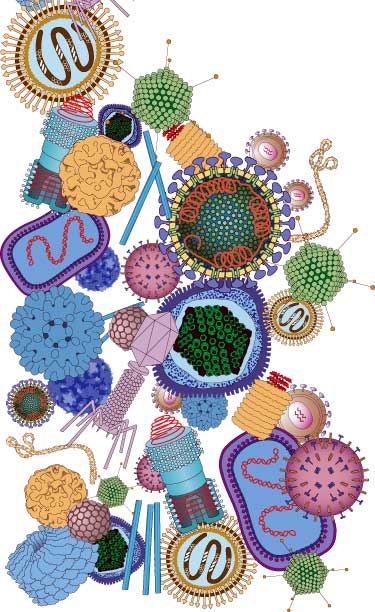
So before we get on with finding out the answer to that simple question, let us see what these viruses are made of. ‘Virus’ is Latin word for ‘Poison’. They are well established as parasites of living beings. They are much smaller than even bacteria and their size ranges from 20nm to 300nm (1nm = 10-9m; cannot be seen using a microscope!). A virus simply consists of a core of nucleic acid (DNA or RNA) enclosed within a protein coat called Capsid. Some viruses have an extra covering made of lipid membrane called Envelope (e.g. HIV- which causes AIDS), but they do not have any machinery for carrying out metabolic activities. Even the simplest and most primitive unicellular organism, the Blue Green algae (also known as Cyanobacteria, 2.8 billion years old fossil samples have been found!), contain protoplasm with membrane bound organelles participating in energy consuming processes. Viruses replicate themselves by utilizing the host cell machinery in a sequence of stages (consisting of adsorption, penetration, uncoating, nucleic acid replication, maturation and release). During Adsorption , the whole virus lands and fixes itself on to the surface of the host cell. This is followed by Penetration in which the Nucleic acid of virus alone enters in to the host cell leaving the protein coat behind. Once inside the cell, the viral genome (nucleic acid) integrates itself with the host cell genome and as the host carries out its normal round of replication, unaware of the presence of viral genome, replicates the viral genes too. These viral genes which code for viral proteins get expressed and result in the formation of many new virus particles. The viruses taken together have genes to counter attack every known form of immune response against them by the host. This is how a virus propagates itself. While outside a host cell it remains dormant waiting to come in to contact with living cell. Air borne viruses like the cold virus remain alive only up to 3 hours outside human body, after which they cannot replicate themselves even when in contact with host.
A virus seems to be on the verge of life, similar to a seed i.e. it looks dead but possesses a certain potential for life. Viruses also have been known to constantly evolve themselves as seen by emergence of new viruses like Swine flu etc. The Eighth report of the International Committee on Taxonomy of Viruses (Taxonomy is the science of classification) reports existence of more than 5450 viruses belonging to more than 2000 species. These viruses infect all type of cells, ranging from bacteria (they are called Bacteriophages) to blue green algae (Cyanophages) and also human beings. A recent report shows that marine viruses help in increasing efficiency of photosynthesis in blue green algae, contributing up to 5% of total world’s oxygen. Apart from this various other genes of viral origin are identified in human beings too, indicating that viruses play a major role in evolution of life on earth. Thus in a way they control life on earth by determining the survival of their hosts. These so called non living beings are closely intertwined in the web of life making them immensely powerful.

