Ever wondered why plants glow after rain? Why rainbows are actually bow shaped? What gives the butterfly its colours or why the stars twinkle? The little moments of 'eureka' that happen in a person's life, changes his perception of things happening around him and leaves him with a desire to explore further. Through this blog we will take you on a journey of thousands of light years into space, explore the invisible world of angstroms, play with atoms and listen to the story that numbers tell.
All narrated in your mother tongue .
Saturday, May 15, 2010
Combinatorics - 3
Thursday, April 1, 2010
The joy of joymetry-3
For comparison, here’s another proof. It’s equally famous, and it’s perhaps the simplest proof that avoids using areas.( Routine text book stuff)
As before, consider a right triangle with sides of length a and b and hypotenuse of length c, as shown below on the left.

Now, by divine inspiration or a stroke of genius, something tells us to draw a line segment perpendicular to the hypotenuse and down to the opposite corner, as shown above on the right. (I use to wonder why during my school days, is it just for the sake of proving it or there is no remote chance of proving it with out the line?)
This clever little construction creates two smaller triangles inside the original one. It’s easy to prove that all these triangles are “similar” — which means they have identical shapes but different sizes. That in turn implies that the lengths of their corresponding parts have the same proportions, which translates into the following set of equations:

We also know that
because our construction merely split the original hypotenuse of length c into two smaller sides of length d and e.At this point you might be feeling a bit lost, or at least unsure of what to do next. There’s a morass of equations above, and we’re trying to whittle them down to deduce that
Nevertheless, by manipulating the right three equations, you can get the theorem to pop out. See the notes below for the missing steps.Would you agree with me that, on aesthetic grounds, this proof is inferior to the first one? For one thing, it drags near the end. And who invited all that algebra to the party? This is supposed to be a geometry event.
But a more serious defect is the proof’s murkiness. By the time you’re done slogging through it, you might believe the theorem (grudgingly), but you still might not see why it’s true.
Reference :
E. Maor, The Pythagorean Theorem: A 4,000-Year History (Princeton University Press, 2007).
New york times.
• Here are the missing steps in the second proof above. Take this equation:
and multiply it by a on both sides to get
Similarly massaging another of the equations yields
Finally, substituting the expressions above for d and e into the equation c = d + e yields
Then multiplying both sides by c gives the desired formula:
Monday, March 29, 2010
The joy of joymetry-2
We can prove the theorem very simply, as follows.
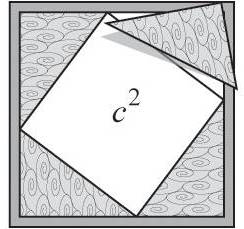
Let’s go back to the tilted square sitting on the hypotenuse.At an instinctive level, this image should make you feel a bit uncomfortable. The square looks potentially unstable, like it might topple or slide down the ramp. And there’s also an unpleasant arbitrariness about which of the four sides of the square gets to touch the triangle.
Guided by these intuitive feelings, let’s add three more copies of the triangle around the square to make a more solid and symmetrical picture:Let’s recall what we’re trying to prove: that the tilted white square in the picture above (which is just our earlier “large square”— it’s still sitting right there on the hypotenuse of the four triangles along the corners of the bigger square) has the same area as the small and medium squares put together. But where are those other squares? Well, we have to shift some triangles around to find them.
Think of the picture above as literally depicting a puzzle, with four triangular pieces wedged into the corners of a rigid puzzle frame.
Now let’s try moving the pieces around in various ways. Of course, nothing we do can ever change the total amount of empty space inside the frame — it’s always whatever area lies outside the pieces.
The brainstorm, then, is to rearrange the pieces like this:
All of a sudden the empty space has changed into the two shapes we’re looking for — the small square and the medium square. And since the total area of empty space always stays the same, we’ve just proved the Pythagorean theorem!
This proof does far more than convincing; it illuminates. That’s what makes it “elegant.”
Next
Sunday, March 28, 2010
The joy of joymetry-1
Many people, I met over the years, have expressed affection for Geometry. Arithmetic and Algebra? — not many takers there, but geometry, well there is something about it that brings a twinkle to the eye.
The Pythagorean theorem is concerned with “right triangles” — meaning those with a right (90-degree) angle at one of the corners. Right triangles are important because they’re what you get if you cut a rectangle in half along its diagonal:
And since rectangles come up often in all sorts of settings, so do right triangles.
Then the theorem says that the large square has the same area as the small and medium squares combined.
Wednesday, January 6, 2010
Combinatorics - 2
One of them was that of secret locks (also called combination locks). These locks open up only when a specific combination of numbers or alphabets is dialed.* One example of such a combination lock is the ATM card pin number. Each pin number has 4 digits and each digit's place can be filled with any of the ten numbers (0, 1, 2... 9). Using the method we have seen earlier, the total number of calculations is found to be 104 = 10000. Which means that of these 10000 combinations, 9999 will be failures. (ATM cards usually stop working after typing the wrong pin number thrice, so even if someone gets your card there is very little chance that they can get the right number in three attempts. 9999 is too big you see!)
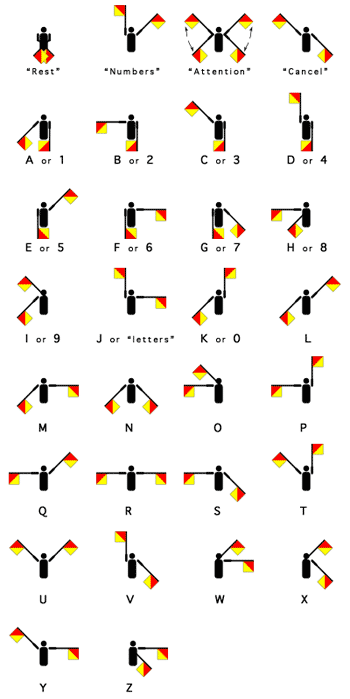
Morse Code
Genetic code
Breaking the genetic code has been one of the most remarkable achievements of the twentieth century. Scientists now know how genetic information is passed on from one generation to the other. The genetic information is stored in giant molecules of deoxyribonucleic acid (DNA). Each molecule of DNA is an arrangement of the four nucleotides (adenine, thymine, guanine and cytosine). Molecules of DNA differ in the arrangement of these nucleotides and they determine the order in which the proteins are built from the 20 amino acids. Each amino acid is in the form of a code made up of three nucleotides. Why codes of only 3 nucleotides? The answer is similar to the one in Morse code. Using combinations of just one or two nucleotides would not result in sufficient number of combinations for the 20 amino acids and the START / STOP functions. Hence, codes of three nucleotides would be required. It is interesting to see how nature takes advantage of so much redundant information – the number of combinations is 64 while the number of amino acids is only one third! (Do find out more about how nature uses the excess of combinations in regulating the protein expression and fighting mutations).
A single chromosome contains millions of nucleotides. The number of distinct chromosomes possible is 4N , where N is the number of nucleotides in the chromosome. The number is just too big to write it down here, however only a very small fraction of these have been sufficient to ensure the diversity of all life on this planet. Why only a few? These are questions yet to be answered.
*Do you remember the CRYPTEX in Dan Brown's book "The Da Vinci Code"? The CRYPTEX is a word coined by Brown for a vault which carries secret messages. The dials on the top of the vault have to be arranged as per the secret code to open the CRYPTEX. Secret messages are written on a papyrus scroll and kept inside the vault. If someone forces open the CRYPTEX, the vial (inside the vault) carrying vinegar will break and the vinegar will dissolve the message on the papyrus scroll; the message will be lost forever. So to access the secret message, we need to have access to the secret code.
NEXT
Friday, January 1, 2010
Combinatorics - 1
Kabani overheard one of her aunts saying "1 is so unlucky for me!". She wondered how it really mattered. Kabani started counting how many other digits were there - 0, 2, 3, 4, 5, 6, 7, 8 and 9 - i.e., nine of them! Then she started counting the number of two-digit numbers which didn't have 1 - 00, 02, 03, 04... - she finally had written down all of them. There were 81 one of them. The most interesting observation she made was that each digit could be followed by any of the nine digits, which meant she could have 9*9 (=81) possible two-digit numbers without 1.
Taking the calculation forward, she predicted that there will 9*9*9 = 729 three-digit numbers without 1 and there would be 9*9*9*9 = 6,561 of those four-digit numbers! Kabani wondered how these numbers would change if her aunt felt that both 1 and 2 were unlucky. The answers were simple, there would be 8 one-digit numbers, 8*8 = 64 two-digit numbers, 8*8*8 = 512 three-digit numbers and 8*8*8*8 = 4,096 four-digit numbers which don't contain 1 or 2!
Permutations with Repetitions
The above problem falls into the following class of problems. There are n different objects. We have to select objects from the above n to fill r vacancies in a straight line. When each of the r vacancies has been filled, we call it an arrangement (also called as r-arrangements). Each r-arrangement can contain more than one object of the same type (this is referred to as repetition) and two r-arrangements would be considered distinct if they vary at least at one of the r positions. The task is to find the total number of such distinct arrangements. These arrangements are called r-permutations of n distinct objects with repetitions. For filling the first vacancy we have n options, for filling the second vacancy we have n options, for the third it is n options and so on. So for filling each of the r vacancies we will have n options and hence the total number of ways we can make the arrangement is nr . It would also be equal to the number of distinct r-arrangement possible.
In the earlier problem, we had to find the number of possible two-digit numbers from 9 distinct digits. The answer would be 92 ! All the calculations of Kabani can now be done easily without wasting much time and energy. Permutations with repetitions have many valuable applications in the world around us, we will explore a few of them in the next article.
NEXT
Combinatorics - 0
Every day we come across passwords. Passwords for computers, passwords for ATMs (commonly referred to as pin number), number locks, and so on. All of these are combinations; some are combinations of alphabets while others are combinations of numbers and still others use symbols; in some cases the passwords are case-sensitive, sometimes they are not.
Among other examples of combinations we can think of – how your teachers come up with the time table, how a metallurgist tries different combinations of elements to come with up an alloy of desired properties, how a linguist examines the meanings of combinations of letters in an unknown language and so on. All of these visibly 'different' applications come under one roof called combinatorics. Combinatorics (or combinatorial mathematics) is a field of mathematics that deals with problems of how many different combinations can be built out of a specific number of objects.
This field has its origin in the gambling games that played a large part in the European high societies in the 16th century. Whole fortunes were won or lost in a game of cards or dice; something very similar to how the Pandavas lost all their fortunes in a game of dice in the Mahabharatha! In how many ways can a certain sum in throws of two or three dice be scored (haven't you played Ludo?), in how many ways is it possible to get two kings in a card game and other similar problems in a game of chance gave the initial push to develop combinatorial mathematics and the theory of probability.
Italian mathematician Tartaglia was among the first to list the various combinations that can be achieved in a game of dice. His list showed the number of ways 'x' dice can fall. However he failed to take into account the fact that the same sum can be achieved in different ways. For example, if we are using 2 dice and we want a sum of 7, the various combinations are (1,6), (2,5) and (3,4).
In the 17th century, Chevalier de Mere, an ardent gambler, had sort the help of his friend Pascal to determine the division of the stakes of an interrupted game of chance. This marked the first theoretical investigation into the problems of combinatorics. Fermat, a contemporary French mathematician, was also working on the same problem. Their work was followed by valuable contributions from Bernoulli, Leibnitz and Euler.
Combinatorics is extensively used in the field of statistics, cryptography, discrete mathematics, linear programming, group theory, non-associative algebra... the list is unending. Most of the names given above might sound new and not of your understandability. However, it is interesting to realise that the mathematics involved in all of them is the same as in a game of dice. Through a series of articles we will travel with Kabani (a student like you) through the field of combinatorics. We will learn to solve problems from the simplest to the toughest, and enjoy the beauty of mathematics. The only thing that you need to know is how to play a game of dice!
Food for thought -
Simplest Question – In a class, every student is to be given a 2-digit roll number. What is the maximum number of students that can be given the roll number?
Toughest Question – There is a queue of x + y persons at a ticket counter of a cinema theatre. x have Rs20 note and y have Rs10 note. Each ticket costs Rs10 and the cashier has no change to start with. In how many ways can the people line up so that the line keeps moving and no one has to wait for change?
Reference – “Combinatorial Mathematics for Recreation” by N. Vilenkin. Translated from the Russian by George Yankovsky
NEXT