Ever wondered why plants glow after rain? Why rainbows are actually bow shaped? What gives the butterfly its colours or why the stars twinkle? The little moments of 'eureka' that happen in a person's life, changes his perception of things happening around him and leaves him with a desire to explore further. Through this blog we will take you on a journey of thousands of light years into space, explore the invisible world of angstroms, play with atoms and listen to the story that numbers tell.

All narrated in your mother tongue .

हिन्दी मे ... தமிழில்

Showing posts with label Rathnakumar. Show all posts

Saturday, May 8, 2010

Decode the bar code

Ever wondered what differentiates a can of diet coke from a jar of peanut butter? If yes then welcome to the club. For answer, one has to look into the ubiquitous black and white stripes on these products, the barcode.

History of barcode dates back to about six decades, when it was invented by Bernard Silver in 1948. (Twenty five years gone by, before it was first used to read a price on a juicy fruit gum on June 26th 1974).Today it act as both a mundane fingerprint of modern life and a cultural icon of retail shops across the world.

Anatomy of a Bar Code is composed of a series of parallel black and white lines. When a scanner's laser beam hits the bar code, the black modules absorb the light, while the white modules reflect light. A photo diode in the scanner decodes the reflected light into an electrical signal, which is amplified and translated into digital code by the scanner's microprocessor (Fig1). That code is then fed into the store's main computer, which finds the price.


Fig 1

Different bar-code languages are used to identify different types of products, like groceries, clothing and electronics. Although many bar-code languages have been developed by the retail and manufacturing industries since they were first adopted in the early 1970's.The most widely used type is the Universal Product Code (U.P.C), found in most groceries and retail stores.
The U.P.C. is a 12-digit code: the first digit identifies the general category of the product; the next five, the product's manufacturer; the next five, the individual item (like Coke, Diet Coke or Caffeine Free Coke), and finally a ''check digit'' that is used to make sure that the code is scanned correctly in the right orientation.

A typical U.P.C., read from left to right (Fig 2), starts with a quiet zone Next comes the left guard pattern, which alerts the scanner and computer system that information is coming. The next modules identify the number of the product category. That number is printed at the lower left margin of the U.P.C. manufacturer. The next five digits identify the manufacturer. Centre guard pattern divides the left and right halves of the bar code. The next five digits on the right side identify the particular product -- e.g., whether it is a 12-ounce jar of Brand X crispy peanut butter or an 8-ounce jar of a smooth one. The check digit (the last digit on the right) is used to make sure that a U.P.C. has been scanned correctly. The computer does the following calculations; if it comes out with the check digit, the scanning was correct. For a U.P.C. that starts with 0 12345 67890: Add the digits in odd positions: 0 + 2 + 4 + 6 + 8 + 0 = 20 Multiply the results by 3: 20 X 3 = 60 Add the digits in even positions: 1 + 3 + 5 + 7 + 9 = 25 Add the last two results: 60 + 25 = 85 Subtracting that answer from the next-highest multiple of 10 should produce the Check Digit: 90 - 85 = 5.


Fig 2

Next time, when u go to a supermarket figure out what these lines implies. Now you know what it means!

Thursday, April 1, 2010

The joy of joymetry-3

Previous

For comparison, here’s another proof. It’s equally famous, and it’s perhaps the simplest proof that avoids using areas.( Routine text book stuff)
As before, consider a right triangle with sides of length a and b and hypotenuse of length c, as shown below on the left.


Now, by divine inspiration or a stroke of genius, something tells us to draw a line segment perpendicular to the hypotenuse and down to the opposite corner, as shown above on the right. (I use to wonder why during my school days, is it just for the sake of proving it or there is no remote chance of proving it with out the line?)
This clever little construction creates two smaller triangles inside the original one. It’s easy to prove that all these triangles are “similar” — which means they have identical shapes but different sizes. That in turn implies that the lengths of their corresponding parts have the same proportions, which translates into the following set of equations:


We also know that

because our construction merely split the original hypotenuse of length c into two smaller sides of length d and e.
At this point you might be feeling a bit lost, or at least unsure of what to do next. There’s a morass of equations above, and we’re trying to whittle them down to deduce that

Nevertheless, by manipulating the right three equations, you can get the theorem to pop out. See the notes below for the missing steps.
Would you agree with me that, on aesthetic grounds, this proof is inferior to the first one? For one thing, it drags near the end. And who invited all that algebra to the party? This is supposed to be a geometry event.
But a more serious defect is the proof’s murkiness. By the time you’re done slogging through it, you might believe the theorem (grudgingly), but you still might not see why it’s true.

Reference :
E. Maor, The Pythagorean Theorem: A 4,000-Year History (Princeton University Press, 2007).
New york times.

• Here are the missing steps in the second proof above. Take this equation:

and multiply it by a on both sides to get

Similarly massaging another of the equations yields

Finally, substituting the expressions above for d and e into the equation c = d + e yields

Then multiplying both sides by c gives the desired formula:

Monday, March 29, 2010

The joy of joymetry-2

Previous

We can prove the theorem very simply, as follows.

Let’s go back to the tilted square sitting on the hypotenuse.

At an instinctive level, this image should make you feel a bit uncomfortable. The square looks potentially unstable, like it might topple or slide down the ramp. And there’s also an unpleasant arbitrariness about which of the four sides of the square gets to touch the triangle.

Guided by these intuitive feelings, let’s add three more copies of the triangle around the square to make a more solid and symmetrical picture:

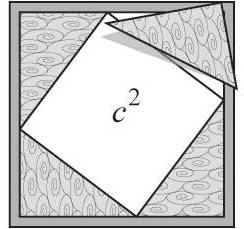
Let’s recall what we’re trying to prove: that the tilted white square in the picture above (which is just our earlier “large square”— it’s still sitting right there on the hypotenuse of the four triangles along the corners of the bigger square) has the same area as the small and medium squares put together. But where are those other squares? Well, we have to shift some triangles around to find them.

Think of the picture above as literally depicting a puzzle, with four triangular pieces wedged into the corners of a rigid puzzle frame.


In this interpretation, the tilted square is the empty space in the middle of the puzzle. The rest of the area inside the frame is occupied by the puzzle pieces.

Now let’s try moving the pieces around in various ways. Of course, nothing we do can ever change the total amount of empty space inside the frame — it’s always whatever area lies outside the pieces.

The brainstorm, then, is to rearrange the pieces like this:

All of a sudden the empty space has changed into the two shapes we’re looking for — the small square and the medium square. And since the total area of empty space always stays the same, we’ve just proved the Pythagorean theorem!

This proof does far more than convincing; it illuminates. That’s what makes it “elegant.”

Next

Sunday, March 28, 2010

The joy of joymetry-1

Is Geometry your favorite math subject in high school?!

Many people, I met over the years, have expressed affection for Geometry. Arithmetic and Algebra? — not many takers there, but geometry, well there is something about it that brings a twinkle to the eye.
I think it’s because geometry kindles the right side of the brain, which appeals to visual thinkers who might otherwise cringe at its cold logic. But other people tell me they loved geometry precisely because it is so logical. The step-by-step reasoning, with each new theorem resting firmly on those already established — that’s the source of satisfaction for many. For those who couldn’t prove certain theorems, the final verse hence proved was a consolation and trick to confuse the examiner (I am told students still follow it.)

My hunch is that people enjoy it because it marries logic and intuition. It feels good to use both halves of our brain isn’t it?
To illustrate the joys of joymetry, let’s revisit the Pythagorean theorem, which you probably remember as a2 + b2=c2. Part of the goal here is to see why it’s true and appreciate why it matters. Beyond that, by proving the theorem in two different ways, we’ll come to see how one proof can be more “elegant” than another, even though both are correct. =
The Pythagorean theorem is concerned with “right triangles” — meaning those with a right (90-degree) angle at one of the corners. Right triangles are important because they’re what you get if you cut a rectangle in half along its diagonal:


And since rectangles come up often in all sorts of settings, so do right triangles.
They arise, for instance, in surveying. If you’re measuring a rectangular field, you might want to know how far it is from one corner to the diagonally opposite corner. (By the way, this is where geometry started, historically — in problems of land measurement, or measuring the earth: geo = “earth” + metry = “measurement.”)
The Pythagorean theorem tells you how long the diagonal is, compared to the sides of the rectangle. If one side has length a and the other has length b, the theorem says the diagonal has length c, where
For some reason, the diagonal is traditionally called the “hypotenuse,” though I’ve never met anyone who knows why. (Any Latin or Greek scholars there?)
Anyway, here’s how the theorem works. To keep the numbers simple, let’s say a = 3 yards and b = 4 yards. Then to figure out the unknown length c, we add 32 and 42, which, in effect is 9 plus 16. (Keep in mind that all of these quantities are now measured in square yards, since we squared the yards as well as the numbers themselves.) Now, since 9 + 16 = 25, we get c2 = 25 square yards, and then take square roots of both sides. This yields c = 5 yards as the length of the hypotenuse.
This way of looking at the Pythagorean theorem makes it seem like a statement about lengths. But traditionally it was viewed as a statement about areas. That becomes clearer when you say it the way they used to say it:
“The square on the hypotenuse is the sum of the squares on the other two sides.” (Math teachers note this)
Notice the word “on.” We’re not speaking of the square “of” the hypotenuse — that’s a excessively modern algebraic concept about multiplying a number (the length of the hypotenuse) by itself C x C. No, we’re literally referring here to a square sitting on the hypotenuse, like this:
Let’s call this the large square, to distinguish it from the small and medium-sized squares we can build on the other two sides:
Then the theorem says that the large square has the same area as the small and medium squares combined.
   Since time immemorial, this marvelous fact has been expressed in a diagram shown below.
Next

Sunday, March 7, 2010

Why does a ship float?


Eureka! Eureka! cried Archimedes, jumped out of his bath tub and ran naked. Perhaps he found an answer to a long standing problem in his mind! Now we know his answer as the Archimedes principle.


Principle:


A body wholly or partly immersed in a fluid, undergoes a loss in weight equal to the weight of the fluid it displaces.

(For e.g.)
An aluminium cube of 1ft length weighing 168lb (Fig 1a), when immersed in water (1cubic feet of water =62lbs) undergoes a weight loss equal to the weight of the displaced water , now its weight has apparently decreased to 106lb [168 lb-62lb] (fig 1b)


Principle of floating:


If a body, on being immersed in a fluid would displace a volume of fluid whose weight is greater than that of the body concerned, then that body will float on the fluid. In other words a body floats when it sinks to such a depth that the displaced fluid weighs exactly as much as the floating body. Buoyancy (acting upward) is said to be in equilibrium with the weight of the body.

For e.g.

A 1ft wooden cube (fig 2) weighing about 50lb will float in water, when the submerged part of the cube displaces a volume of water weighting 50lb, counter- balancing the weight of the cube.

What’s the case with the ship?

Apart from floating, a ship must additionally be able to reorient itself after being swung to an inclined position by external force such as wind pressure.
Fig 3a shows the ship in normal position. The weight of this ship acts downward at its centre of gravity S. The counter balancing upward force acts at the centre of buoyancy W, which is the centre of gravity of the displaced volume of water. In normal position (Figure 3a) the points S and W are on the same vertical line. When the ship heels over (Figure 3b & 3c) the centre of gravity of the displaced water shifts to a different position W’.


The upward movement acting here strives to rotate the ship around its centre of gravity S. the intersecting point of the upward force A with the ships axis of symmetry ( vertical dotted line) is called the metacentre M. If the metacentre is located above the centre of gravity S (Fig 3b) the ship will float and return to its normal upright position. On the other hand if the metacentre is below the centre of gravity S (Fig 3c) the ship will capsize when it heels over.

Reference:
An illustrated encyclopedia of technology, Heron books. C.Van Amerongen.